
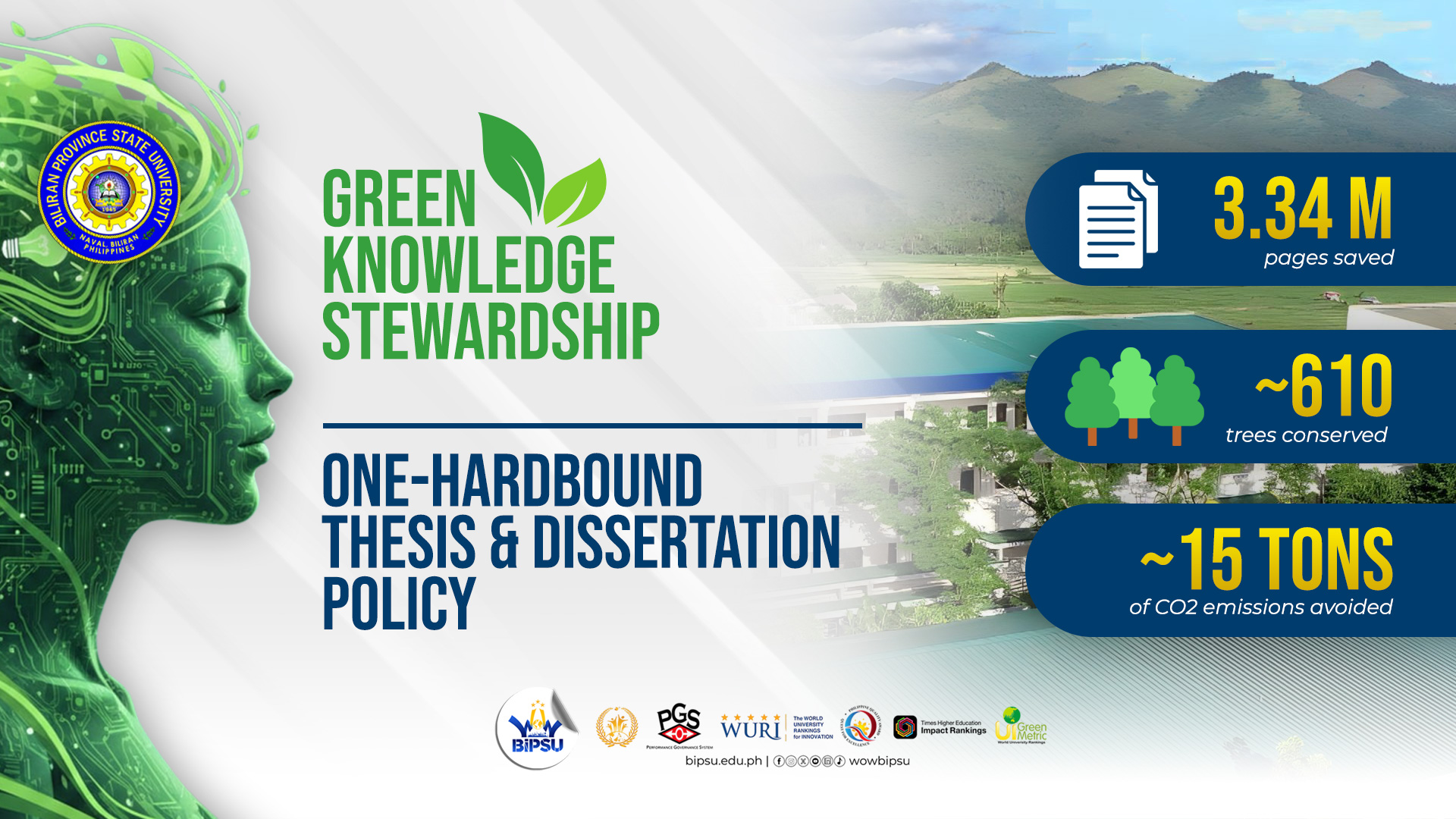
Biliran Province State University (BiPSU) has positioned itself at the forefront of sustainability-driven academic reform after becoming the pioneering higher education institution in the Philippines to formally implement a one-hardbound thesis and dissertation policy through the Green Knowledge Stewardship, which marks a shift toward digital-first research governance while preserving academic rigor and archival integrity.
Unveiled during the General Faculty and Staff Solidarity Meeting on February 02, 2026 at the university gymnasium led by University President Prof. Victor C. Cañezo Jr., this initiative limits the submission of undergraduate theses and graduate dissertations to a single printed and hardbound copy for official historical purposes, with all other required copies submitted electronically.
“The reform responds to the growing need for environmentally responsible practices in higher education, particularly in research production, where traditional multi-copy printing has long contributed to excessive paper use and rising student costs,” Prof. Cañezo stated.
This policy, brainchild by the BiPSU president himself, was developed in close coordination with the university’s Research and Development Office (RDO). According to him, the initiative reflects a broader commitment to modernizing research systems while embedding sustainability into institutional blueprint.
Environmental and economic assessments conducted by the University served as the empirical foundation of the policy. Data indicate that limiting thesis and dissertation submissions to one hardbound copy could save approximately 3.34 million pages of paper, conserve an estimated 610 trees, and prevent around 15 tons of carbon dioxide emissions associated with printing and paper production.
These findings were drawn from two internal studies titled “Avoided CO₂ Emissions from Reduced Thesis Printing: A Four-Year BiPSU Case and National Projections in the Philippines” by Prof. Victor C. Cañezo, Jr. and Dr. Ruffy Rodrigo, and the “Economic Cost of One Hardbound Policy” by Prof. Cañezo and Dr. Annel Ruth Celis, which examined the environmental impact of reduced thesis printing and the economic costs borne by students under traditional multi-copy requirements.
Beyond nature-friendly, this Weaving of Worthiness (WoW) initiative directly addresses long-standing concerns over the financial burden placed on students. Printing, binding, and reproducing multiple hardbound copies of research manuscripts have often added significant expenses to graduation requirements. Easing these demands, the university aims to promote equitable access to research completion while allowing students to focus resources on the quality and substance of their academic work.
Corollary to the implementation of this policy is the strengthening of BiPSU’s digital research infrastructure. Theses and dissertations are now archived through BiPSU ScholarsHUB, the university’s institutional research repository, which ensures long-term preservation, accessibility, and transparency of scholarly outputs.
“A centralized digital archiving not only improves access to research across the academic community but also enhances monitoring, citation, and knowledge-sharing within and beyond the campus,” Prof. Cañezo shared.
BiPSU has aligned this program with national and global development frameworks, citing its consistency with the Commission on Higher Education’s (CHED) A.C.H.I.E.V.E. Agenda and the United Nations Sustainable Development Goals 4: Quality Education, 12: Responsible Consumption and Production, 13: Climate Action, and 16: Strong Institutions. Further, it is anchored in official university issuances, including the Memorandum Circular No. 10, s. 2025, Board Resolution No. 106, s. 2025, and Research and Innovation Manual and Revised Research Agenda (2025-2028).
Prof. Cañezo, supported by the university officials, believes the Green Knowledge Stewardship policy represents a model for other higher education institutions seeking to balance academic excellence with environmental responsibility and student-centered governance.
Realistically, 21 other State Universities and Colleges (SUCs) under CHED Commissioner and BiPSU Board of Regents Chair Dr. Michelle Aguilar Ong have pledged their commitment in supporting the implementation of the policy, which is bound to be launched nationwide this month.
As the university continues to roll it out across the country through partnerships and information campaigns, BiPSU highlights its guiding principle of safeguarding knowledge while protecting the environment. In doing so, the institution redefines how academic traditions can evolve in response to the demands of sustainability, innovation, and inclusive education in the modern era.
One print. One purpose. One sustainable future. With this act of weaving innovation and responsibility, the university reveals how deeply its roots are anchored in going green.
As a prime mover, BiPSU hopes to influence broader conversations on how knowledge is produced, preserved, and shared in the Philippine’s academic sector.
#WoWBiPSU #GreenKnowledge
-
 0
0
-
 7
7
-
 0
0
-
 0
0
-
 0
0
-
 0
0