
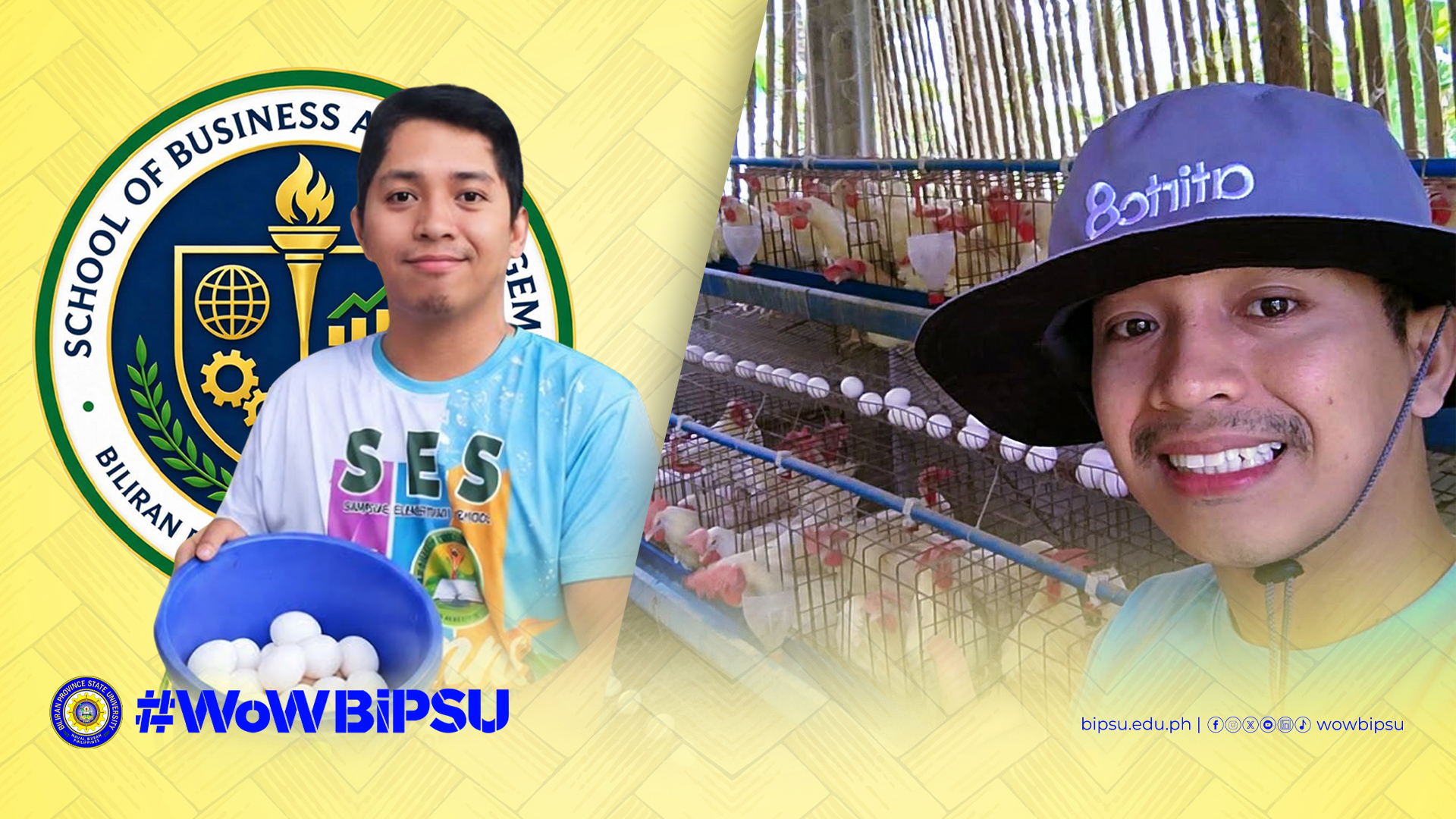
As BiPSU turns its former BSBA Department into the School of Business and Management, alumnus Reggie Calvez offers a glimpse of what business education can become when classroom knowledge finds its way into the community.
There are many ways to measure whether a school has evolved.
At times, it is seen in a new building rising where an old one once stood. Sometimes, it is written in a board resolution that gives an academic unit a new name, a wider mandate, and a bigger responsibility. And, it can likewise be known inside a poultry house of a young entrepreneur, where the meaning of business education becomes tangible.
Reggie Calvez, a Bachelor of Science in Business Administration (BSBA) graduate of then Naval State University (NSU), now Biliran Province State University (BiPSU) has emerged as an awarded agribusiness owner in the province.
Beneath his poultry in Barangay Sampao, Almeria, hundreds of chickens move between feeders and nesting spaces, their restless fluttering blending with the steady sounds of a farm coming to life. The air carries the familiar warmth of poultry, while rows of hens fill the space with movement. Somewhere between the rustle of feathers and the routine of feeding, eggs are gathered—small, ordinary products that have become the foundation of a growing enterprise.
The lessons he gained in the University now sustains him into the agriculture business. His enterprise, Calvez Regg’s Poultry Farm, also known as Atong Itlog ni Bai, began with 100 ready-to-lay chickens in May 2025. This year, it has 200. And after being named a Young Farmers Challenge (YFC) Upscale Category Awardee on September 4, 2026 with a ₱300,000 grant, he is preparing to add another 300.
In this moment, the journey of Reggie becomes a story about what happens when a university grows—and its graduates grow with it.
A school grows from a legacy
Business education has long been part of BiPSU identity. Since 2005, what is now the School of Business and Management (SBM) has existed as the Department of Business Administration under the School of Arts and Sciences (SAS). From that unit came thousands of graduates who have gone on to work in financial institutions, corporations, entrepreneurial ventures, government offices, and other organizations throughout the globe.
But institutions, much like the people they serve, eventually grow beyond the structures that once contained them.
Through BiPSU Board Resolution No. 27, series of 2026, the former Business Administration department has evolved into a full-fledged School of Business and Management—an academic identity with a broader mandate and a clearer space to respond to the changing world of enterprise.
Matter of fact, business no longer moves at the pace it used to. Artificial intelligence is changing how companies operate. Digital commerce allows even small enterprises to reach customers beyond their communities. A movement in the peso can affect the price of goods on a neighborhood table. A change in economic policy can open a door for one entrepreneur while closing another.
This is where business education becomes more than accounting formulas, marketing principles, or management theories. Because behind every enterprise is a person, behind every employee is a family, and behind every salary received is a household that can buy food, keep a child in school, or finally afford something that once seemed out of reach. Business, therefore, is never only about profit; it is about people.
The emergence of SBM gives BiPSU a stronger platform to deepen industry partnerships, pursue specialized research, strengthen its academic programs, and prepare graduates whose leadership reaches beyond financial success toward responsible and ethical enterprise.
For Dean Dr. Claire Theresa Bentor, the milestone represents the beginning of a new chapter—one that continues the University’s vision of developing competent, innovative, and socially responsible professionals.
“We are honored to become part of every student’s journey toward becoming future leaders, entrepreneurs, and changemakers,” she shared. “In the SBM, we S-trive, B-uild, and M-ake an impact.”
This academic year, the school carries that vision through 53 faculty members and two academic programs: BS Business Administration major in Marketing Management, headed by Mr. Hans Christian Molina, and BS Business Administration major in Financial Management, headed by Mr. Crismar Hoylar. Together, they serve 1,748 students—827 in Marketing Management and 921 in Financial Management.
It is a sizable academic community. Yet, the more meaningful measure of a school is not how many students sit inside its classrooms. It is what those students eventually do with what they learned there.
In that long list of graduates is Reggie, a young man who took his business education somewhere few might have expected—back to the farm.
A business and a home
Long before Reggie learned about marketing strategies and financial management, he was already familiar with the smell of a farm. He grew up in a farming family. Animal care, planting, selling, and the everyday work of agriculture were part of his childhood. The farm was not a business case in a textbook, it was simply life.
Yet after graduating from NSU in 2018, agriculture was not immediately where his career took him. He went to Manila. There, he worked as a telesales representative and later as an operations officer. His BSBA degree became useful in ways he perhaps could not have fully appreciated while still in college. Marketing helped him understand selling and customers. Finance helped him make sense of money and budgets. More importantly, working in the corporate environment gave him another perspective on how businesses succeed—or struggle.
Then, eventually, the road led home. Agriculture was still there. Only this time, Reggie was looking at it through the eyes of a business graduate. “Agriculture became part of my identity,” he said.
In 2024, that identity found an opportunity through the Young Farmers Challenge, a program by the Department of Agriculture (DA).
He took the chance. Then, he won the Provincial Start-Up Category, receiving ₱80,000. That first award became the seed. On May 2, 2025, Reggie used the opportunity to begin his poultry venture with 100 ready-to-lay chickens. There was nothing grand about the beginning; just a flock, a farm, a provincial entrepreneur, and the eagerness to find out whether a small idea could become something bigger.
Where the lessons met the land
Walk into Reggie's poultry operation today and the vocabulary of business takes on a different sound.
Demand is no longer a definition written, it is the customer asking whether there are enough eggs available. Budgeting is no longer an exercise, it is knowing how much can be spent without putting the next production cycle at risk. Marketing is no longer a chapter in a textbook, it is the conversation with a customer who decides whether to buy again. Management is no longer an examination, it is the daily responsibility of making sure the operation works. For Reggie, his BSBA education has become a practical tool.
He applies what he learned, where every business decision carries real consequences. This is where education becomes more than a credential. It becomes capacity—the ability to look at what one has, understand what the market needs, calculate what is possible, and then make something grow.
The real competition was within
Yet every enterprise has its own uncertainty.
The egg market is competitive. Expenses can be unpredictable. Every entrepreneur knows the uncomfortable space between investing and waiting to see whether the capital will pay off.
Reggie knows that space well. There were moments when fear of failure became its own kind of burden. What if the business will not work? What if he lost money? What if the market was already too saturated? Eventually, however, he came to a realization which became one of his strongest motivations: “Sarili ko lang din ang kalaban ko.” [My only enemy is myself.]
He was his own biggest opponent. The market could be difficult, but fear could be more paralyzing. So he chose not to surrender to it. He worked harder, he prayed, and he continued.
“Hindi ko hinayaan ang takot na mangibabaw, bagkus ginalingan ko at mas ginagalingan ko pa,” [I didn’t let fear take over; instead, I gave it my best and keep pushing to do even better,] Reggie expressed. “Isang chance lang, papatunayan ko na kaya ko.” [Just one chance, I'll prove that I can do it.]
That was his biggest challenge in navigating a business. Today, he reaps the beauty of it. Among the things he treasures most about the business is not simply its profitability, yet seeing customers return.
For Reggie, a successful enterprise is built through relationships as much as transactions. A customer may come because they need eggs, but they return because they trust the product and the person behind it. That belief reflects the marketer in him.
On winning as a young Biliranon farmer
His first YFC recognition in 2024 gave him ₱80,000 and the opportunity to walk. His latest one gives him room to run.
This month, Reggie was named a Young Farmers Challenge – Upscale Category Awardee, securing a ₱300,000 grant for his bigger flock. His next plan, straightforward, bringing the farm’s projected population to 500 chickens.
For the young farmer, that number represents more than scale, it represents confidence and the possibility that a micro enterprise can become a stable source of livelihood. Besides, it reflects what business education often seeks to cultivate: the ability to see opportunity where others may see only limitations.
Notably, Reggie also bagged the Outstanding Business Plan for the YFC Upscale category. This showcases that his growing enterprise is not built on opportunity alone, but on careful planning, sound business thinking, and the ability to translate an idea into a viable and scalable agricultural venture.
Reggie credits many people for helping him reach this point. He remembers the provincial agriculture office, as well as the DA Agribusiness and Marketing Assistance Division (AMAD) Region VIII, whose guidance and support remained throughout the journey. He thanks his family, whose farming background gave him his earliest tie to agriculture. Equally, he extends gratitude to his college instructors, whose lessons in business continue to live inside the enterprise he now manages.
“Ang pagkapanalo ko ay panalo nating lahat,” [My victory is everyone’s victory,] Reggie shared.
Building an entrepreneur
Long before Reggie learned to manage a poultry enterprise, he was learning to manage something more personal: himself.
As a BSBA student at BiPSU, who majored in Marketing and Financial Management, Reggie was not the kind of student who easily walked into a room and struck up conversations. He grew up shy and quiet, and he openly recognized communication as one of his weaknesses. For someone studying business—a field built around people, negotiations, presentations and linkages—it was a challenge he could not simply ignore.
But he did not allow it to become a reason to stop.
He continued his studies, even as he carried the discomfort of speaking and interacting with others. Along the way, he met people who became sources of inspiration, helping him confront the very weakness he once thought defined him.
What happened next became more significant than simply becoming better at communicating. He discovered himself.
“Siguro para sa iba, maliit na bagay ang tinatawag ko na kahinaan, pero para sa akin, ang mapagtagumpayan ito ay walang katumbas na kaligayahan,” [To others, what I call a weakness might seem like a small thing, but for me, overcoming it brings a happiness beyond compare,] Reggie stated. “Sapagkat doon ko lang naramdaman na, kaya ko pala, kaya ko lahat!” [Because it was only then that I felt I could do it—that I could do anything!]
From that realization came something that would eventually become part of his greatest assets as an entrepreneur: confidence and trust in himself.
That confidence did not remain inside the classroom. It followed him into his work with corporate clients and in agribusiness, where he would have to make decisions as an entrepreneur carrying risks. Conceivably, this is where the making of an entrepreneur truly begins—not when the first business is registered, not when the first product is sold, and not even when the first profit is earned. It begins when an individual learns to believe that he is capable of building something.
As per Reggie, BiPSU became part of that discovery. The business lessons gave him knowledge to work with, the people he encountered helped him overcome a personal limitation, and the self-esteem he gradually built gave him the courage to take those lessons beyond the university.
He carries the quiet victory of a student who once questioned his ability to communicate, but eventually learned to trust his own capacity to grow. Before he learned how to build a business, he first learned how to build himself.
What a business school mean to a community
In March 2025, BiPSU’s Bachelor of Science in Business Administration program achieved the highest distinction of Level IV Phase 2 Re-accredited status from the Accrediting Agency of Chartered Colleges and Universities in the Philippines (AACUP), making it the only higher education institution in Eastern Visayas to have attained this accreditation status as of this writing. Moreover, both of its offered programs—Marketing Management and Financial Management—have secured Certificates of Program Compliance (COPC), signifying that they have met the regulatory standards and requirements for the continued delivery of quality academic courses.
These accomplishments underline the merit and strength of business education at Biliran Province State University, reflecting its commitment to maintaining rigorous academic standards, developing industry-ready graduates, and providing students with education that is responsive to the demands of a changing economy and business landscape.
Moreso, the founding of the SBM comes at a time when the meaning of entrepreneurship is becoming increasingly important to communities like Biliran.
The business school can teach students how to manage capital, but its deeper purpose is to teach them how to create value. It can teach them how to understand markets, but also how to understand the people within those markets. It can teach them how to pursue profit, but also why responsible enterprise matters.
Because when a business succeeds, its impact rarely stops with the owner.
A farm that grows may need more workers, a store that expands may buy from more suppliers, a local enterprise may keep money circulating within the community. An entrepreneur who succeeds may become the reason another individual begins to believe that entrepreneurship is possible and rewarding.
Wherefore, the SBM matters to the communities it serves, and reciprocally. It is not simply a change in organizational structure, it is a statement about what the university believes its business graduates can become.
Future leaders, entrepreneurs, changemakers.
Not merely people who can enter the workforce, but people who can help shape it. Not merely graduates who look for opportunities, but graduates who can create them. Not merely business professionals who know how to make money, but accountable citizens who understand that business decisions eventually reach human lives.
Reggie’s story gives that vision a face.
Shaped by the graduates
Since the establishment of the Department of Business Administration under its first-ever dean, Dr. John Anthony Romagos, the school’s true footprint isn't measured in brick and mortar, but in the world its graduates build.
Enrollment figures, faculty strength, programs, facilities, accreditation, research, partnership—these matter. But there is another worth that cannot always fit neatly into an institutional report.
Look at what its graduates create. Look at the businesses they establish. The people they employ. The communities they transform. The problems they solve. The dreams they make feasible for others.
For two decades, among the generations of graduates the SBM has produced and sent into the world, Reggie showcases what that journey can look like.
His path did not follow a straight line. He graduated with a non-board business degree, he worked in the city, he returned to agriculture, he entered a competition, he started with 100 chickens, he doubled the flock, he faced uncertainties, he persisted, and now, he is preparing to upscale even more with 500 ready-to-lay chickens.
That is not simply a success story about poultry. It is a story about possibility.
Chase excellence and let success follow
By the time the morning work is done at the poultry farm, the trays of eggs have been gathered, the chickens have been tended to, and another day of business has begun. For Reggie, however, the farm represents more than an expanding enterprise. Sixteen months after starting business operations, it becomes a place where the lessons he learned as a student continue to take shape—through brilliance, progress, service, and the discipline to do things well even when no one is watching.
These are values that extend beyond business. They are values that BiPSU hones in its students: competence anchored in character, excellence matched with responsibility, and knowledge put into meaningful service.
Reminiscing about his own journey, Reggie recounted that when he was still a business student, he often wondered when success would finally come. When will he get there? Will he ever succeed?
Today, standing on the other side of that doubt, he has a different answer.
He draws inspiration from a line associated with Phunsukh Wangdu in the film 3 Idiots: “Follow excellence, and success will chase you.” These words have become more than a memorable line from a film. His experience in business and agriculture has given the idea a life of its own.
He urges students not to make money or even become a successful businessman as their sole destination. Instead, pursue brilliance in whatever is in front of them. “When studying, study not merely to pass, but to understand,” Reggie said. “Learn not simply to complete requirements, but to acquire knowledge that can eventually be used wisely.”
According to him, when the time comes for the BiPSU students to build a business, they should give their best service. They must offer quality, and take care of the people who place their trust in them. Because success, he believes, is often a consequence rather than a destination. When excellence is what you chase, the success, income, and customers will eventually begin to follow you.
In Sampao, a young alumnus is already living that lesson. The eggs may be small, but each one carries the possibility of something more. Much like the students now filling the classrooms of SBM, they are reminders that growth does not happen all at once. It begins tiny—with one lesson discerned, one skill developed, one decision made rational, and one person passionate to pursue excellence.
In the country, agriculture remains one of the important economic foundations. In 2025, the Agriculture, Forestry, and Fishing (AFF) sector accounted for 7.9% of the Philippines’ gross domestic product and grew by 3.1%, recovering from a contraction the previous year. More notably for young entrepreneurs like Reggie Calvez, poultry and egg production grew by 9.1%.
BiPSU contributes to this continuing development by preparing graduates who can take what they learn in the classroom and turn it into solutions, enterprises, and opportunities within their communities.
Through its newly established School of Business and Management, the University continues to strengthen this commitment—developing students not only to become capable professionals, but also critical thinkers, ethical entrepreneurs, innovative leaders, and community builders who can respond to the needs of a fluctuating economy.
#WoWBiPSU
[This article aligns with the UN Sustainable Development Goals (SDGs), particularly SDG 4: Quality Education and SDG 8: Decent Work and Economic Growth.]
-
 0
0
-
 2
2
-
 0
0
-
 0
0
-
 0
0
-
 0
0