
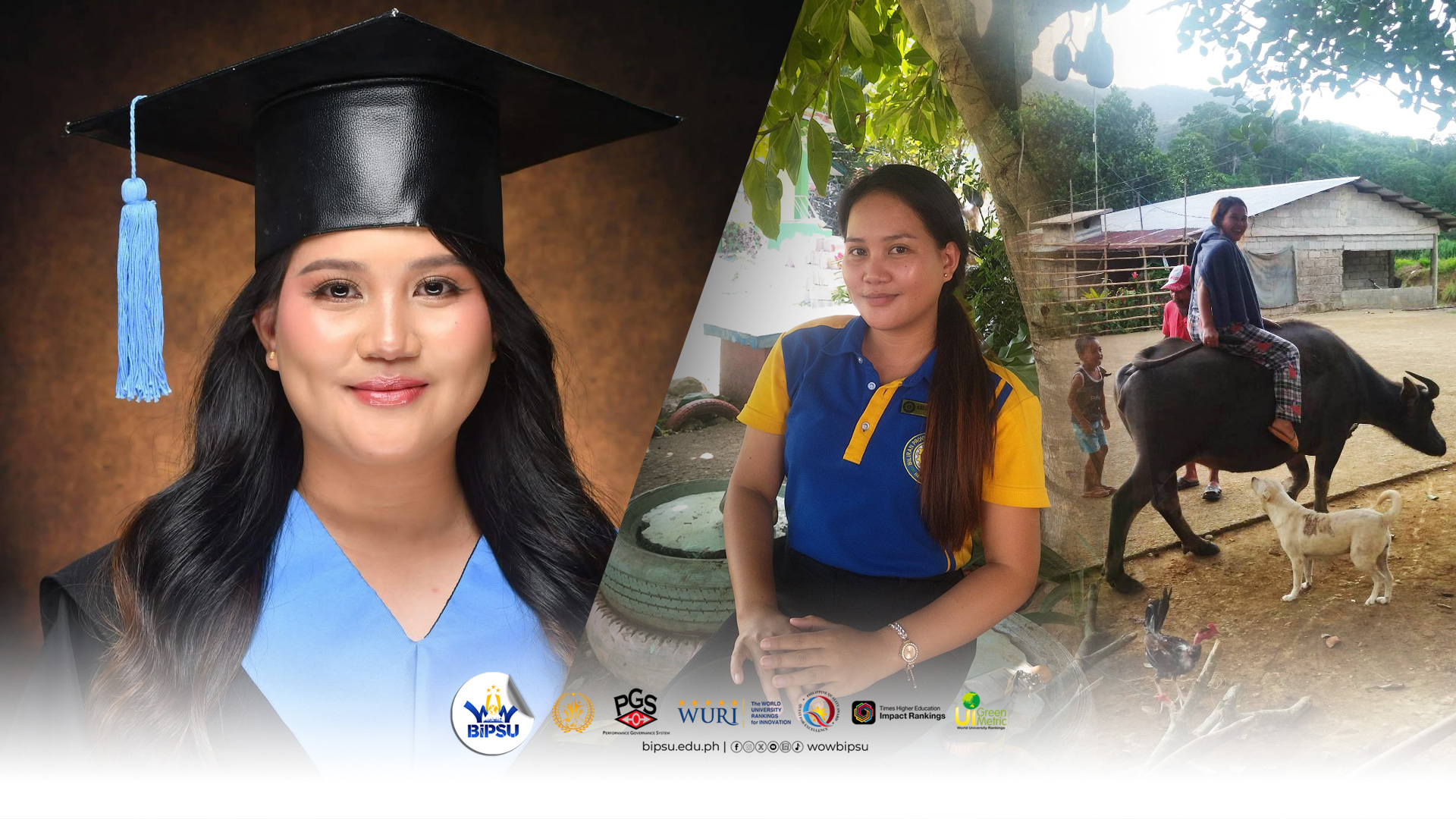
In balancing the scales between those born with a silver spoon and those who live hand-to-mouth, do the underprivileged truly have the capacity to rise? This story declared it yes, with 81.80% certainty.
Among the five pioneering scholars of Biliran Province State University's (BiPSU) Affirmative Action Scholarship Program who earned their bachelor's degree during the 47th Commencement Exercises in May 2025 is Donna Abrigo, now a Licensed Professional Teacher (LPT) after passing the September 2025 Board Licensure Examination for Professional Teachers (BLEPT).
Abrigo, a former sales clerk, was shadowed by poverty. Heavy mist clung to the mountain foot of Sitio Palayan, Almeria, Biliran, where she grew up, wrapping the Mamanwa tribe in a quiet that only roosters and rustling leaves could break. Dawn arrived slowly there, where smoke curled from small kitchens made of wood and tin. The earth smelled of damp soil and firewood. In that highland silence, a hopeful daughter once stood barefoot outside their home, watching her mother prepare for another day of labor, her father already on the rice terraces.
In every movement of her hands—fetching water, sweeping dust from the bamboo floor, helping prepare the morning meal—there was a soft vow forming. “I will become a teacher,” she told herself, long before she understood how heavy that promise would become.
“Tubong bukid ra man na siya.” [She's just a provincial bumpkin,] they would say. It was as if the mountain were a limitation. It was as if distance were destiny.
At a young age, Abrigo understood that life does not unfold evenly. She was not born with the weight of a silver spoon in her mouth but with responsibilities in her hands. As one of the impecunious children, she learned early how to balance chores with schoolwork and dreams with duty. She walked long, uneven paths to attend classes, sometimes under a punishing sun, sometimes beneath skies ready to break into rain. Her bag was never new, and her notebooks were sometimes half-filled with recycled pages.
But her eyes—her eyes carried something unborrowed and unbreakable.
When she entered college at BiPSU, the terrain changed, yet the struggle remained. The classroom was larger, the lessons heavier, and the expenses sharper. There were days when transportation fare was a computation. Days when projects required money that did not exist in her pocket. Days when hunger and humiliation tried to sit beside her in lectures. Around her were classmates with complete materials, stable allowances, and lighter worries. She smiled politely, but inside she wrestled with questions she dared not voice: Will I survive this semester? Will I make it to graduation?
The 1987 Philippine Constitution, Article XIV Section 1, promised education as a right for all. Abrigo believed it; she held onto it like scripture. But rights, she learned, must sometimes be fought for quietly—through sleepless nights, borrowed money, bravery in harder challenges, and pride swallowed whole.
There were moments she stumbled. Subjects that challenged her confidence. Situations when the mountain girl in her felt too small in the vastness of academia. Yet she stood up each time, with the stubborn strength of someone who had climbed hills since childhood.
Then came the University's Affirmative Action Scholarship Program through President Victor C. Cañezo, Jr.—a bridge she did not know was being built for someone like her. It did not erase poverty. It did not flatten the mountain. But it gave her footing. It told her, without fanfare, that BiPSU sees students beyond privilege. Somewhere within institutional policies and budget lines, there was a belief that being underprivileged does not mean being undercapable.
From being a saleslady, Abrigo received tremendous help from the said scholarship. She shared that without the program’s assistance, managing her academics alongside working would have been tough. It truly created opportunities for her and allowed her to concentrate on her studies.
“The program blessed me more than just with financial help; it also gave me hope and encouragement," said Abrigo in an interview. "As an indigent, I once thought my dreams were out of reach, but BiPSU gave me the chance to pursue my passion for education and reminded me that no dream is ever too big when you're given the right support.”
More radiant than the celestial bodies, her once-bleak hopes bloomed a rosy hue, nurtured by the invigorating benefits. With the university's Affirmative Action, she was handed a living allowance of PhP 2,500.00 per month, which also covers meals, transportation, and other incidental expenses; all other expenses not covered by UniFAST, such as Related Learning Experience (RLE), including on-the-job training (OJT) fees, internships, and other required fees of the enrolled program; ready-made uniforms prescribed by the program; and free accommodation in the dormitory.
Years later, in 2025, Abrigo successfully marched on stage as a graduate of the School of Teacher Education (STEd) in the Bachelor of Elementary Education program, where social stigma and impossible odds became a black toga and a life-defining victory.
Then, the review season for BLEPT arrived, presenting another mountain to climb.
To enrol in a review center and earn her license, a down payment was required. Money again stood like a gatekeeper. Her mother borrowed funds to secure a slot at Falculan Twin Review Centre. They chose to pay in installments, stretching the sacrifice across months. Abrigo attended sessions carrying more than review notes—she carried expectations. Mock board exams tested not only her knowledge but also her courage; low scores whispered that maybe she is not ready. Doubt pressed against her ribs.
Besides, there was fear beyond academics. Each night she walked home, wary of a mentally unstable man who waited along the road. Her steps were quick; her prayers were quicker. Still, she reviewed.
On the eve of the board examination, she could not quiet her mind. Though advised to relax, she clung to group study as if it were a lifeline. Sleep came late, and she left early. On the morning of the exam, she skipped breakfast, her stomach too tight with fear. Before she could even write her name, her hands trembled violently.
“Lord, ikaw na bahala" [Lord, I surrender it to you,] she whispered, calling on every saint she could remember. “Bahalag 78%, Lord, basta pasar lang.” [Even if it’s just 78%, enough to pass.] From the first item to the last, each uncertain answer carried a prayer. Her hand ached, and her neck stiffened. Her thoughts raced toward her parents, her neighbors in the Mamanwa community, BiPSU, and every person who had believed in her. What if she fails? What if she disappoints them?
The heavens had listened before. They listened again.
When the results were released in December, Abrigo searched for her name with breath suspended between fear and hope. And there it was. Passed.
She had prayed for 78 percent, and heaven gave her an 81.80 overall rating. Eighty-three percent (83%) in general education and 81% in professional education. For the first time, her family had a teacher. Tears came not as noise but as relief. The mountain girl had crossed another summit.
Today, as an LPT, Abrigo speaks gently yet firmly about educational inequality. She knows firsthand that while the Constitution promised to provide education and make it accessible to all, the quality often bends toward those with means. Wealth studies beneath steady electricity, guided by tutors, and surrounded by quiet rooms and reliable gadgets that make learning seamless. Poverty studies just as earnestly, though often beneath flickering bulbs, in homes where space is shared, and silence is rare, turning scarcity into discipline. Yet she is a testament to the fact that when institutions decide to act—when scholarships are not mere lines in a document but lifelines extended to the margins—the gaps can narrow.
This year, the Department of Education (DepEd) bears the highest national budget allocation. Numbers that large often feel abstract, mere figures printed on paper. But in truth, those allocations breathe. They walk and must climb to the dots on the country map. They should be felt inside classrooms. Abrigo's story is empirical evidence that taxes paid by Filipinos have won another human life. Philippine taxation serves not only revenue collection but also the reduction of social inequality. A nation that invests in its learners is a nation that invests in justice.
The future is not the same landscape as yesterday. Abrigo understands that the classroom she is about to enter is not the same as yesterday's. Tomorrow is no longer chalk and blackboard alone; it is artificial intelligence, digital literacy, and the urgency to protect quality in an age of rapid change. She aspires to live the profession with courage to confront the learning gaps exposed by poverty, to navigate technology responsibly, and to embody programs like Academic Recovery and Accessible Learning (ARAL) that aim to recover and strengthen foundational skills. For her, teaching is not just employment; it is participation in a national healing.
Abrigo dedicates her feat to the Almighty God, to her parents who sacrificed without hesitation, to educators who rallied behind her, and to University President Cañezo, whose Affirmative Action initiative reached the truly marginalized.
“Sa maka-usa pa, daghan kaayong salamat po, Pres., sa pagdasig sa ako na maghuman og eskwela.” [Thank you very much, President, for encouraging me to study and pursue education.] Abrigo approached Prof. Cañezo during the Testimonial Dinner for the Newly Licensed Professional Teachers on January 20 at the university gymnasium.
Doctor of Education (EdD) himself, Prof. Cañezo, congratulated her, reaffirming that being a teacher means recognizing that a single decision can either save or wipe out a community. “I am happy for your success, and I hope that a single chance for a scholarship redraws your entire future,” he said.
In BiPSU, intergenerational responsibility is vital. With its life-changing service and by providing opportunities to those who lack them, this organization’s responsibility transcends the current generation.
From fog-filled mornings and muddy walks in her community to the solemn oath of a Licensed Professional Teacher, Abrigo's journey bends the narrative of limitation.
“As an educator produced by BiPSU, I aspire to be one who inspires and uplifts students, helping them believe in themselves and achieve their dreams just like I did,” she expressed.
The scale between silver spoon and hand-to-mouth may never be perfectly equal. But in one transformative scholarship program, one borrowed review fee, one trembling examination hand, one consistent prayer, and one institution that chose inclusion over indifference, the balance shifted in 81.80 degrees.
And somewhere in the highlands where stars remain visible against the pitch-black sky, a new light now burns—not only for her family, not only for BiPSU, but for generations yet to climb.
As a state university, BiPSU remains dedicated to creating opportunities, ensuring that education does not bend toward privilege but rises to meet those in the margins. It walks faithfully to transform public funds into public goods, to carry learners across difficult terrains, and to shape professionals whose success echoes beyond personal triumph.
#32ndHigherEducationMonth #BiPSUAffirmativeActionScholar #WoWBiPSU
-
 1
1
-
 6
6
-
 0
0
-
 0
0
-
 0
0
-
 0
0