UMIO News

Biliran Province State University (BiPSU) Vice-President for Academic Affairs Dr. Maribel N. Zipagan recently represented the institution at the 27th ASEAN University Network-Quality Assurance (AUN-QA) Tier 1 Training held at the Crowne Plaza in Bangkok, Thailand. The intensive four-day training, which took place from January 13 to 16, 2026, focused on equipping academic leaders with the comprehensive knowledge and practical skills required to navigate the AUN-QA Framework at the program level. Dr. Zipagan joined a diverse cohort of educators from across the region to master the complexities of international accreditation and quality assurance.

Throughout the program, Dr. Zipagan participated in a balanced regimen of theoretical discussions and hands-on workshops facilitated by recognized AUN-QA experts. The training covered essential criteria such as expected learning outcomes, program specifications, and the Plan-Do-Check-Act (PDCA) approach to academic development. A significant portion of the session was dedicated to curriculum mapping, where Dr. Zipagan engaged in simulation exercises to align courses with Program Learning Outcomes (PLOs), ensuring that BiPSU’s academic offerings remain constructively aligned with global standards.

The participation of the Vice-President highlights the university's aggressive push toward international benchmarking and outcomes-based education. By mastering the eight AUN-QA Program Assessment Criteria—which range from academic staff quality to quality enhancement—Dr. Zipagan has gained vital insights necessary to lead BiPSU through future international program assessments. This engagement is a key step in strengthening the university’s internal quality assurance mechanisms and ensuring its graduates meet the rigorous demands of the regional labor market.

Following her return, the University President Prof. Victor C. Cañezo, Jr., EdD, CHRP commended this achievement, stating that Dr. Zipagan’s efforts are essential in "weaving BiPSU with the world and the world with BiPSU" through the elevation of academic programs and the alignment of institutional standards with the ASEAN region.

Upon the successful completion of the workshop, Dr. Zipagan was awarded a certificate of completion by the AUN-QA Secretariat during the closing ceremony. This milestone marks a significant step for the Vice-President and signals BiPSU's increasing readiness to compete and collaborate within the ASEAN higher education landscape.

#WoWBiPSU

Paglinang at pag-igting. [Cultivation and intensification.]

Donned in electric blue that conveys power, depth and elegance, Biliran Province State University (BiPSU) President Prof. Victor Catigbe Cañezo, Jr. delivered the 2026 State of the University Address (SUA) with both retrospect and resolve, unfolding a narrative of transformation that has carried the university from modest provincial beginnings to the threshold of national competitiveness, on February 26 at the BiPSU Gymnasium. 

Standing before prominent attendances of Commission on Higher Education (CHED) Commissioner Dr. Michelle Aguilar-Ong, CHED Regional Office VIII Director Maximo Aljibe III, Biliran Provincial Governor Hon. Rogelio J. Espina, BiPSU Board of Regents, representatives from various State Universities and Colleges (SUCs) in Eastern Visayas, local leaders, university officials, faculty and students, Prof. Cañezo presented  a sweeping account of BiPSU’s blooming growth and planted down a promising roadmap, reigniting the Weaving of Worthiness (WoW) BiPSU 2.0 era.

The address reflected on nearly a decade of reforms beginning in 2017, when the university embarked on aggressive restructuring in governance, research, instruction, infrastructure, and digital transformation, wherein Fiscal Year 2025 emerged as a milestone year.

BiPSU stood among only 14 out of roughly 300 national government agencies to receive a perfect performance rating from the Department of Budget and Management (DBM), and the only institution in the Visayas to achieve the distinction. The university also secured its sixth consecutive Performance-Based Bonus and earned the ARTA Silver Award for advancing digital public service delivery. In sustainability, BiPSU ranked first in the Philippines under the infrastructure category of the UI GreenMetric World University Rankings, affirming its investments in environmentally responsible campus planning.

Enrollment growth signaled increasing public trust. From 7,188 students in 2017, BiPSU’s population rose to nearly 13,000 in 2025—a 58.3 percent increase that reflects expanded access and strengthened academic reputation. The university recorded a 79.69% average passing rate across licensure examinations in the same year and has produced 12 national top-notchers since 2015. Graduate employability reached 55.50%, surpassing its institutional target of 48 percent, a development Prof. Cañezo attributed to curriculum alignment, industry linkages, and strengthened internship programs.

“Our graduates didn't just graduate. They are working, contributing, and creating impact,” he stated.

Moreover, a notable innovation highlighted in the address was the implementation of the Two-Shift Class System, designed to maximize physical resources while accommodating working students and addressing classroom congestion. This system, described as the first and only among state universities in the Philippines, has enabled BiPSU to expand enrollment without sacrificing instructional quality.

Research output demonstrated one of the university’s most dramatic transformations. From having almost zero indexed publications in 2017, BiPSU now reports 238 Scopus-indexed publications as of 2025. It ranks second in Eastern Visayas and 14th nationwide among higher education institutions in research productivity. Extension services likewise expanded exponentially, from 821 beneficiaries to 53,340 individuals reached, signaling deeper community integration and responsive outreach programs.

Further, infrastructure development remains central to the WoW BiPSU 2.0 agenda. Construction is underway for “Hotel de BiPSU,” a five-storey dormitory with swimming pool valued at ₱125 million, intended to provide accessible accommodation for students from geographically isolated and disadvantaged areas. A modern Learning Resource Center, envisioned as a flagship academic facility, is targeted for completion by August 2026. Phase 2 of the Science and Technology Research Center will commence this year, while development plans for the BiPSU Caibiran External Campus continue to advance. Smart classrooms are increasing to 20 air-conditioned, technology-equipped learning spaces.

Digital transformation initiatives form another cornerstone of the institution’s modernization drive. Through “BiPSU Insights,” administrators aim to deploy an integrated real-time analytic system to monitor performance indicators across schools and offices.

“A ₱59-million allocation has been set for Smart Campus innovations, including AI-supported instructional technologies, upgraded servers, and campus-wide connectivity improvements designed to streamline academic and administrative services,” he added.

Likewise underway is academic expansion. Applications are being steadfast processed for new programs to open such as the Juris Doctor and Master of Science in Nursing, alongside the reopening of the Maritime program. The Bachelor of Science in Industrial Security Management (BSISM) is confirmed to launch in Academic Year 2026–2027, broadening the university’s professional offerings.

Beyond numbers and infrastructure, Prof. Cañezo emphasized BiPSU’s social mandate. Continued support for indigenous communities, particularly the Mamanwa tribe, remains embedded in its Affirmative Action initiatives. The university sustains assistance to typhoon-affected communities and is planning the establishment of a Child Minding Center to support student-parents and employees. Its Green Knowledge Stewardship policy, which promotes digital archiving and reduced paper consumption, reinforces its commitment to environmental sustainability and responsible resource management.

Concluding this year’s SUA, President Cañezo positioned BiPSU within a broader regional and national landscape. He sets eyes for the university to attain SUC Level IV status by 2027 and aspires to secure recognition in the QS Asia Rankings—milestones that would elevate its academic standing beyond island boundaries.

The 2026 State of the University Address ultimately woven that a provincial state university, through strategic planning, fiscal discipline, research investment, and community-centered governance, can recalibrate its trajectory. For BiPSU, the shift toward “2.0” is not merely a cultivation of growth, but an intensification toward global competitiveness while remaining rooted in its mandate of public service.

#WoWBiPSU #SUA2026

In a resounding demonstration of the academic excellence and professional grit fostered within the university, the School of Management and Entrepreneurship (SME) at Biliran Province State University (BiPSU) celebrates the successful absorption of 28 top-performing On-the-Job Trainees into permanent professional positions. As of February 4, 2026, these newly minted professionals have transitioned from interns to full-time staff within reputable hospitality establishments across Manila, Cebu, Tacloban, and Ormoc.

Reflecting on this milestone, BiPSU President Prof. Victor C. Cañezo, Jr., EdD, CHRP, underscored the university’s mission to bridge the gap between education and industry, noting that the rapid hiring of these students validates the "Wow BiPSU" brand as a hallmark of excellence.

"The absorption of our 28 SME students into prestigious hospitality establishments is a powerful validation of our 'Wow BiPSU' brand of excellence and the weaving of worthiness in every graduate," Prof. Cañezo stated. "This success proves that our curriculum is not only theoretically sound but also practically relevant to the evolving needs of the global market. We are committed to further strengthening our industry partnerships to ensure that every BiPSUnista is equipped with the competence and character to thrive in their chosen professions immediately upon graduation."

This mass hiring highlights the efficacy of a mentorship-driven OJT program designed to meet rigorous CHED standards. By focusing on experiential learning, the SME has transformed the traditional internship into a direct recruitment pipeline.

“This outcome affirms that SME internships are clear pathways to employment, not merely academic requirements,” said Ms. Charis Ma. Amor R. Mangco, BSHM OJT Coordinator. Her statement reinforces the institutional commitment to ensuring students are not just degree-holders, but industry-ready assets.

The Ramada Hotel – Manila officially welcomed Marlon Timon, Gerald Elle, Judy Verwin, and Teodoro Gaviola Jr. into their professional ranks, marking a significant BiPSU presence in the nation's capital. Meanwhile, the luxury shores of Cebu saw a massive influx of talent, with Jan Alquinze Obaob, Meagan Rose E. Delantar, John Henry Posa, Arjay Jacobe, Donna Vhil Bereño, Mark Jhune Laude, and Raniela Kristine Rezul joining the team at Costabella Resort.

The momentum continued in Tacloban, where XYZ Hotel absorbed a ten-member powerhouse team consisting of Malvin M. Doroteo, Cristian E. Demate, Christian Luna, Geraldine Salazar, Jonalyn S. Caparro, Jenny Rose Verutiao, Rica N. Delima, Princess Fajardo, Giselle Cominguez, and Ronel Rosende. Additionally, Edwin Calvez secured his future at Rosvenil Hotel – Tacloban.

In the world of high-end resorts, John Rovic P. Bagdoc and Carmel C. Jutara were hired by JPark Island Resort, while Ivy Comedia joined Tambuli Seaside Living in Cebu. The success extended to Ormoc, where Arlo Solayao was absorbed by Copenhagen Residences, and Aaron Dave Layola alongside Marianne Pagatpat joined the team at Sabin Resort Hotel.

The ability of these students to secure permanent contracts before even finishing their final academic requirements highlights a deep-seated employer confidence in the BiPSU brand. This achievement is a testament to the dedication of the SME faculty and the university’s commitment to structured workplace immersion. These 28 professionals now stand as true ambassadors of BiPSU-SME excellence and service leadership, proving the strength of a victorious Biliran Province State University.

#WoWBiPSU #WoWBiPSUnista #BiPSUInternsInFocus

[𝘗𝘩𝘰𝘵𝘰𝘴 𝘊𝘰𝘶𝘳𝘵𝘦𝘴𝘺 𝘰𝘧 𝘉𝘪𝘗𝘚𝘜-𝘚𝘔𝘌]

Biliran Province State University (BiPSU) continues to bolster its commitment to student welfare and experiential learning through expanded industry collaborations that have provided significant financial and logistical support to its student-trainees since the onset of their deployment.

Since July 2025, 43 Bachelor of Industrial Technology students have been undergoing their On-the-Job Training (OJT) at the Alturas Group of Companies in Bohol. From the beginning of their internship, these trainees have received a daily allowance of two hundred fifty pesos (₱250), conveniently distributed through ATM cards. To further ease the financial burden of out-of-town deployment, the host company has consistently provided the students with free board and lodging throughout their program.

Similarly, 15 BSIT–Automotive students deployed at Show and Go in Tacloban City have been receiving comprehensive support since the start of their training. The company has granted these trainees incentives specifically to cover their Related Learning Experience (RLE) fees, while also providing free board and lodging to ensure their welfare during their stay in the regional capital.

Broadening the scope of experiential learning, seven out of 14 Bachelor of Science in Agriculture major in General Agriculture OJT students participated in the Kadiwa ng Pangulo activity held at the Department of Agriculture Regional Field Office VIII (DA RFO VIII) carpark in Kanhuraw Hill, Tacloban City, on February 5 and 6.

The 4th-year students, who began their internship at Diko’s Integrated Farm owned by Mr. Mark Durotan on January 7, 2026, engaged in the activity as an off-farm component designed to immerse them in the agricultural value chain. Through the program, the students were given hands-on exposure to real-world market operations and agricultural trade alongside various farmers, entrepreneurs, and cooperatives from across Eastern Visayas.

Ms. Franz Abegail Escalante, one of the participants, described the experience as meaningful and eye-opening. "Joining the Kadiwa program as a first timer was a great honor for me. It made me realize that selling products is not as easy as it seems, and I gained a lot of knowledge and insights about handling a business from the people I interacted with," she said.

Prof. Victor C. Cañezo, Jr., EdD, CHRP, BiPSU President and President of PASUC VIII, expressed his gratitude for these diverse learning opportunities.

"Our partnerships with the Alturas Group of Companies and Show and Go, as well as our collaboration with the Department of Agriculture RO8, are testaments to our 'Weaving Worthiness' mantra. By securing these incentives and real-world exposures since the start of their journey, we ensure our students have the resources and dignity to excel in any environment."

The university extends its deepest appreciation to all industry partners for their holistic investment in the next generation of Filipino leaders. These initiatives underscore BiPSU’s strategic focus on workforce readiness and its dedication to "weaving BiPSU with the world, and the world with BiPSU," paving the way for a Victorious BiPSU.

#WoWBiPSU #WoWBiPSUnista #BiPSUInternsInFocus

[𝘗𝘩𝘰𝘵𝘰𝘴 𝘊𝘰𝘶𝘳𝘵𝘦𝘴𝘺 𝘰𝘧 𝘉𝘪𝘗𝘚𝘜-𝘚𝘛𝘊𝘚 𝘢𝘯𝘥  𝘛𝘩𝘦 𝘝𝘪𝘴𝘵𝘢 𝘗𝘶𝘣𝘭𝘪𝘤𝘢𝘵𝘪𝘰𝘯]

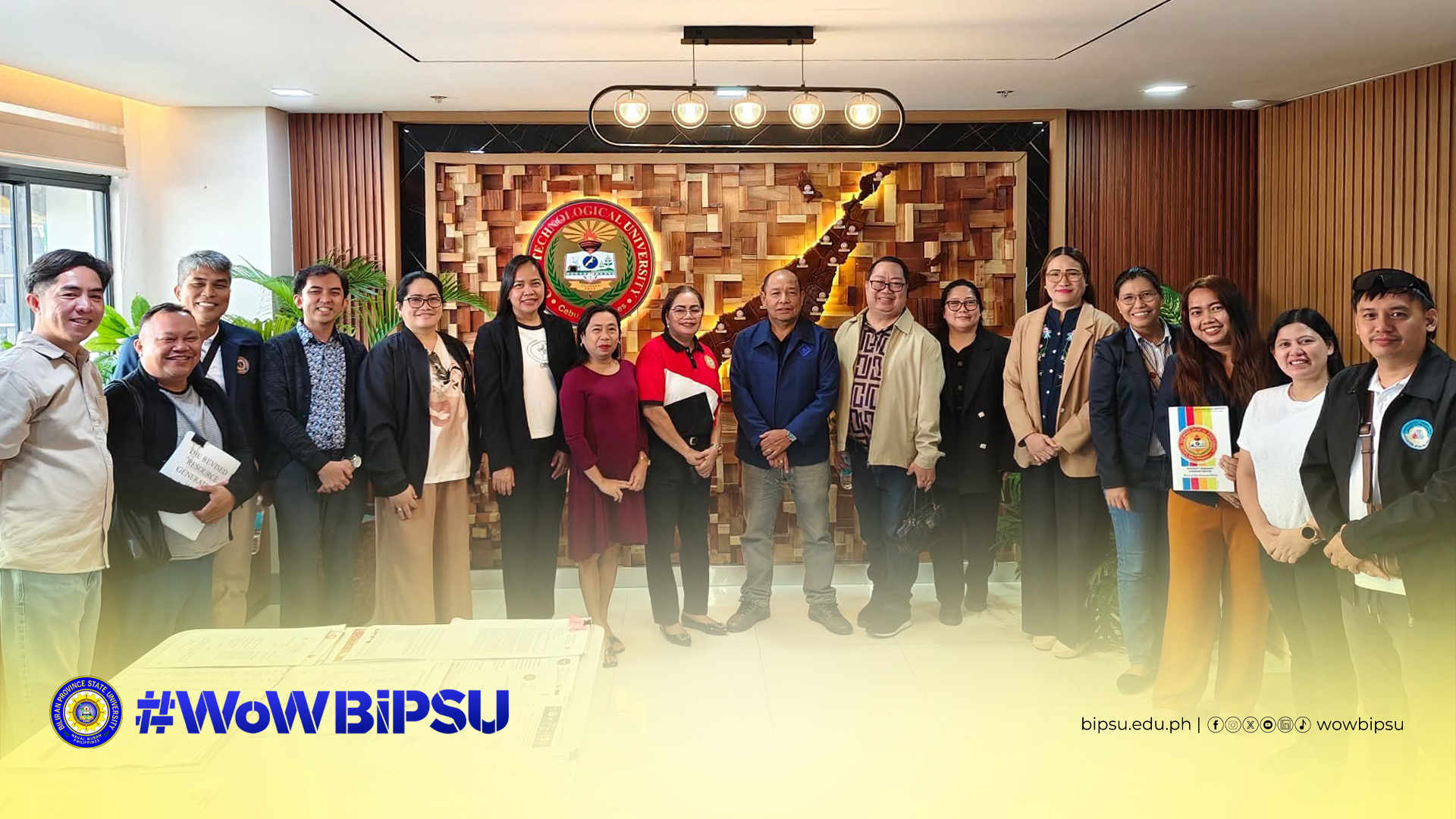
Biliran Province State University (BiPSU) is moving closer to expanding its footprint within the province following a recent high-level meeting with the local government of Caibiran.

University President Prof. Victor C. Canezo, Jr. led a university delegation on February 9, 2026 for a courtesy visit to Caibiran Mayor Rhodessa Delante-Revita. The primary focus of the dialogue was the proposed establishment of a BiPSU external campus within the municipality of Caibiran, a move aimed at decentralizing higher education and making it more reachable for residents in the area.

According to the University President, the initiative aligns with a long-term vision to ensure quality education is accessible to more Biliranons. He emphasized that bringing academic institutions directly into communities removes significant barriers for students, making career opportunities more inclusive and personal dreams more attainable.

The university administration expressed optimism regarding the partnership, noting the warm reception and openness shown by the Caibiran local government unit. Joining the President during the visit were Faculty Regent Hon. Vennie Coton, Board Secretary V Mr. Joedel Peñaranda, and Legal Officer Atty. Dick Guiller Delfin.

As discussions progress, both the university and the LGU are working toward a formal collaboration that would eventually realize the goal of a fully operational campus in the municipality.

#WoWBiPSU

[𝘗𝘩𝘰𝘵𝘰𝘴 𝘊𝘰𝘶𝘳𝘵𝘦𝘴𝘺 𝘰𝘧 𝘔𝘢𝘺𝘰𝘳 𝘙𝘩𝘰𝘥𝘦𝘴𝘴𝘢 𝘋𝘦𝘭𝘢𝘯𝘵𝘦-𝘙𝘦𝘷𝘪𝘵𝘢]

Representatives from Biliran Province State University (BiPSU) and the Department of Education (DepEd) Division of Biliran convened at the BiPSU Convergence Room on February 12, 2026 to discuss collaborative initiatives for language-based education.

The meeting involved the BiPSU Sentro ng Wikang Filipino (SWK), as well as faculty members from the Filipino, Special Needs, and Social Studies departments. They met with DepEd officials led by Henry T. Jarina, Education Program Supervisor (EPS) in Filipino, to map out future programs and research projects.

Discussions focused on three primary areas: Meticulous Writing in the Filipino Language, Filipino Sign Language (FSL), and Indigenous People Education (IPEd). The participants explored ways to synchronize their efforts in developing educational materials and conducting research that aligns with national standards and local needs.

University  President Prof. Victor C. Cañezo, Jr., EdD, CHRP emphasized the importance of this partnership in fulfilling the university’s mission of inclusive service. "This collaboration is a testament to our commitment to making education accessible and culturally sensitive for every Biliranon. By working closely with DepEd, we ensure that our research and language programs translate into tangible benefits for our learners, from our indigenous communities to those requiring specialized communication support," Prof. Cañezo stated.

The gathering aimed to strengthen the partnership and cooperation between the SWK, the university faculty, and the DepEd division. This synergy is expected to lead to a more effective and meaningful implementation of language programs across the province’s basic and higher education sectors.

Through this collaboration, BiPSU and DepEd Biliran seek to enhance the quality of instruction and ensure that educational services remain inclusive and responsive to the diverse needs of learners in the region.

#WoWBiPSU 

The Biliran Province State University – School of Agri-Fisheries (BiPSU-SAF), in partnership with the Municipal Agriculture Services Office (MASO)-Naval, recently conducted two Benchmarking and Industry Exposure Activities in Baybay City, Leyte, for its partner Abaca Farmers’ Associations. The visits provided local farmers with direct access to the National Abaca Research Center at Visayas State University (NARC–VSU), Ching Bee Trading Corporation, and Specialty Pulp Manufacturing, Inc. (SPMI).

The Upland Farmers and Abaca Planters Association (UFAPA) participated in the activity on February 4, followed by the Villa Consuelo Tree Planters Agriculture Cooperative (VCTPAC) on February 11. A total of 52 farmer-members joined the benchmarking sessions to gain insights into modern production and market standards.

At NARC–VSU, farmers were oriented on abaca micropropagation and tissue culture techniques, learning how a single plant can produce thousands of disease-free planting materials. They also observed both hand and machine stripping operations, allowing them to compare fiber quality and efficiency. Beyond raw fiber, participants explored handicraft production, where abaca waste is transformed into value-added products like bags.

The exposure continued at Ching Bee Trading Corporation, a major Grading and Baling Establishment (GBE). Farmers observed the rigorous classification of fibers—ranging from the high-quality, light-colored S2 grade to the darker, lower-grade M1. This firsthand look helped the associations understand the specific quality standards required by large-scale traders. At SPMI, an export-oriented company registered with PEZA, the group witnessed the transformation of abaca into pulp used for tea bags, medical masks, and technical papers.

BiPSU President Dr. Victor C. Cañezo, Jr. emphasized the university's commitment to bridging the gap between small-scale farmers and the global market.

"Our role extends beyond the classroom; we are here to empower our local communities by providing them with the technical knowledge and industry linkages they need to thrive. By exposing our farmers to high-level processing and grading standards, we are helping them transform abaca farming from a survival activity into a sustainable and profitable enterprise," Dr. Cañezo stated.

Mr. Romulo Amaga, President of VCTPAC, expressed his gratitude for the initiative, noting that the exposure has provided much-needed inspiration. He shared that while their area has plenty of abaca, low prices often discourage harvesting. He highlighted that learning about the entire value chain—from propagation to direct market links—has encouraged the cooperative to persevere in their production efforts.

The university expressed its sincere gratitude to the leadership at NARC–VSU, Ching Bee, and SPMI for their expertise. Recognition was also given to MASO-Naval, PhilFIDA-Biliran, and the VSU Alumni & Community Relations Office for their roles in facilitating the successful event.

This initiative is part of a two-year partnership under the Sustainable Abaca Farming and Financial Empowerment Program, benefiting farmers across Libtong, Villa Canija, Caray-Caray, Anislagan, and Villa Consuelo. By strengthening the link between academia, government, and industry, BiPSU continues to advance the United Nations Sustainable Development Goals, particularly those focused on ending poverty, promoting decent work, and fostering responsible production through strategic partnerships. #WoWBiPSU 

[𝘗𝘩𝘰𝘵𝘰𝘴  𝘊𝘰𝘶𝘳𝘵𝘦𝘴𝘺 𝘰𝘧  𝘒𝘳𝘪𝘴𝘵𝘪𝘢𝘯 𝘌𝘥 𝘕𝘢𝘳𝘵𝘦𝘢] 

In preparation for the upcoming Academic Year 2026-2027, Biliran Province State University (BiPSU), through its Admission and Retention Office (ARO), has launched a series of strategic initiatives aimed at streamlining the application process and fostering a more inclusive environment for prospective students.

The university kicked off its preparations with an Admission Information Caravan held from January 19 to 21, 2026. The ARO team traveled across various partner senior high schools in Biliran and Leyte, distributing Information, Education, and Communication (IEC) materials and installing admission guides on campuses.

By providing Grade 12 students with direct access to application requirements and schedules, the university aims to eliminate barriers to entry and ensure that every eligible student in the region is well-informed and ready to apply.

On February 4, 2026, the ARO shifted its focus to internal readiness by conducting the Testing Personnel Orientation Program. The session was designed to equip proctors and examiners with the protocols necessary for a secure and efficient entrance examination.

A central theme of this year’s orientation was the inclusion of applicants with disabilities (PWDs). In partnership with NORFIL Foundation Inc., resource speakers Marites Nachor, Nick Jade R. Jadulco, and Ma. Crisanta Jesseca N. Pecolera provided specialized training on proper assessment and accommodations.

"These efforts align with Sustainable Development Goal 4 (SDG 4) on Quality Education, emphasizing the creation of accessible learning environments for all," the office stated, reinforcing BiPSU’s commitment to equitable testing practices.

The University views the admission process as the foundational step of a student’s undergraduate journey. By focusing on both clear external communication and rigorous internal training, BiPSU seeks to uphold its core values of accessibility, reliability, and excellence.

As the entrance examination season approaches, the university continues to refine its "student-centered" approach, ensuring that the first point of contact for incoming students is one of support and efficiency. #WoWBiPSU 

[𝘗𝘩𝘰𝘵𝘰𝘴 𝘊𝘰𝘶𝘳𝘵𝘦𝘴𝘺 𝘰𝘧 𝘈𝘥𝘮𝘪𝘴𝘴𝘪𝘰𝘯 𝘢𝘯𝘥 𝘙𝘦𝘵𝘦𝘯𝘵𝘪𝘰𝘯 𝘖𝘧𝘧𝘪𝘤𝘦]


Today marks a pivotal chapter in our institutional narrative. On February 13, we celebrate BiPSU Day, commemorating the date in 2019 when Republic Act No. 11170 officially took effect, renaming our institution to Biliran Province State University.

This transition was more than just a change of name; it was a testament to our growth as the premier higher education institution for the entire province. The journey of BiPSU is a rich narrative of evolution, tracing its roots from a community-driven local high school to a modern state university.

The story began with the establishment of Naval High School on October 30, 1945, through Municipal Resolution No. 35. Its first major transformation occurred on June 19, 1965, when Republic Act 4309 converted it into the Naval Institute of Technology (NIT). Under its first president, Mr. Alfredo C. Josep, the college began offering vocational and engineering courses, eventually establishing a tradition of celebrating its founding anniversary on August 31—marking the date in 1972 when the national government first allocated its operational budget.

The university’s history is also a story of convergence with the Biliran National Agricultural College (BNAC). Established in 1949 as Biliran High School and later converted into an agricultural college via Republic Act 5983 in 1969, BNAC officially merged with NIT on October 14, 2009, through Republic Act 9718. This law converted NIT into the Naval State University (NSU) and formally integrated BNAC as its Biliran Campus.

The most recent legislative milestone was realized through the visionary support of our leaders. Authored by then Biliran Lone District Representative and now Governor Rogelio J. Espina, MD, FPOA, and co-sponsored by Senator Francis "Chiz" G. Escudero, Republic Act No. 11170 was signed into law by President Rodrigo Duterte on January 2, 2019. The law officially took effect on February 13, 2019, renaming the institution to Biliran Province State University to better reflect its expansive role in serving the entire province.

Republic Act 11170 did more than change a name; it redefined the university's governance. It established a Board of Regents comprising the CHED Chairperson, the University President, legislative chairpersons from the Senate and House, and regional directors from NEDA, DOST, and the Department of Agriculture. The board also includes leaders from faculty, student, and alumni federations, along with prominent private citizens. To ensure stability during this era of change, the law mandated that the incumbent OIC President of NSU serve as the first full-fledged President of BiPSU.

Today, under the leadership of Dr. Victor C. Cañezo, Jr., and the BiPSU 2.0 Development Plan, we continue to expand our mission—providing advanced technological and professional instruction that empowers the people of Biliran and beyond. As we celebrate BiPSU Day, we honor the "WoW BiPSU" spirit and the legacy of "weaving worthiness" that connects our rich history to a limitless future.

Happy BiPSU Day to all students, faculty, staff, and alumni!

#WoWBiPSU

In a testament to the growing research caliber of Biliran Province State University (BiPSU), Mr. Loudie B. Suliva, a faculty member from the School of Engineering, has been formally recognized for his significant contributions to the international scientific community.

The International Journal of Electrical and Computer Engineering (IJECE) recently awarded Mr. Suliva a certificate of recognition for his dedicated service as a Reviewer. The IJECE is a prestigious, Scopus-indexed publication under the Institute of Advanced Engineering and Science (IAES), known for maintaining rigorous academic standards in the fields of electrical and computer engineering

Peer review is a critical pillar of the academic world, ensuring that published research meets high standards of quality, validity, and innovation. By serving as a reviewer for a Scopus-indexed journal, Mr. Suliva not only contributes to global scientific advancement but also elevates the academic profile of BiPSU.

This achievement aligns with the University’s mission to foster a culture of research and innovation among its faculty, encouraging them to engage with international networks and contribute to the global body of knowledge.

#WoWBiPSU #FacultyCaliber

Biliran Province State University (BiPSU) has positioned itself at the forefront of sustainability-driven academic reform after becoming the pioneering higher education institution in the Philippines to formally implement a one-hardbound thesis and dissertation policy through the Green Knowledge Stewardship, which marks a shift toward digital-first research governance while preserving academic rigor and archival integrity.

Unveiled during the General Faculty and Staff Solidarity Meeting on February 02, 2026 at the university gymnasium led by University President Prof. Victor C. Cañezo Jr., this initiative limits the submission of undergraduate theses and graduate dissertations to a single printed and hardbound copy for official historical purposes, with all other required copies submitted electronically.

“The reform responds to the growing need for environmentally responsible practices in higher education, particularly in research production, where traditional multi-copy printing has long contributed to excessive paper use and rising student costs,” Prof. Cañezo stated.

This policy, brainchild by the BiPSU president himself, was developed in close coordination with the university’s Research and Development Office (RDO). According to him, the initiative reflects a broader commitment to modernizing research systems while embedding sustainability into institutional blueprint. 

Environmental and economic assessments conducted by the University served as the empirical foundation of the policy. Data indicate that limiting thesis and dissertation submissions to one hardbound copy could save approximately 3.34 million pages of paper, conserve an estimated 610 trees, and prevent around 15 tons of carbon dioxide emissions associated with printing and paper production.

These findings were drawn from two internal studies titled “Avoided CO₂ Emissions from Reduced Thesis Printing: A Four-Year BiPSU Case and National Projections in the Philippines” by Prof. Victor C. Cañezo, Jr. and Dr. Ruffy Rodrigo, and the “Economic Cost of One Hardbound Policy” by Prof. Cañezo and Dr. Annel Ruth Celis, which examined the environmental impact of reduced thesis printing and the economic costs borne by students under traditional multi-copy requirements.

Beyond nature-friendly, this Weaving of Worthiness (WoW) initiative directly addresses long-standing concerns over the financial burden placed on students. Printing, binding, and reproducing multiple hardbound copies of research manuscripts have often added significant expenses to graduation requirements. Easing these demands, the university aims to promote equitable access to research completion while allowing students to focus resources on the quality and substance of their academic work.

Corollary to the implementation of this policy is the strengthening of BiPSU’s digital research infrastructure. Theses and dissertations are now archived through BiPSU ScholarsHUB, the university’s institutional research repository, which ensures long-term preservation, accessibility, and transparency of scholarly outputs.

“A centralized digital archiving not only improves access to research across the academic community but also enhances monitoring, citation, and knowledge-sharing within and beyond the campus,” Prof. Cañezo shared.

BiPSU has aligned this program with national and global development frameworks, citing its consistency with the Commission on Higher Education’s (CHED) A.C.H.I.E.V.E. Agenda and the United Nations Sustainable Development Goals 4: Quality Education, 12: Responsible Consumption and Production, 13: Climate Action, and 16: Strong Institutions. Further, it is anchored in official university issuances, including the Memorandum Circular No. 10, s. 2025, Board Resolution No. 106, s. 2025, and Research and Innovation Manual and Revised Research Agenda (2025-2028).

Prof. Cañezo, supported by the university officials, believes the Green Knowledge Stewardship policy represents a model for other higher education institutions seeking to balance academic excellence with environmental responsibility and student-centered governance. 

Realistically, 21 other State Universities and Colleges (SUCs) under CHED Commissioner and BiPSU Board of Regents Chair Dr. Michelle Aguilar Ong have pledged their commitment in supporting the implementation of the policy, which is bound to be launched nationwide this month.

As the university continues to roll it out across the country through partnerships and information campaigns, BiPSU highlights its guiding principle of safeguarding knowledge while protecting the environment. In doing so, the institution redefines how academic traditions can evolve in response to the demands of sustainability, innovation, and inclusive education in the modern era.

One print. One purpose. One sustainable future. With this act of weaving innovation and responsibility, the university reveals how deeply its roots are anchored in going green.

As a prime mover, BiPSU hopes to influence broader conversations on how knowledge is produced, preserved, and shared in the Philippine’s academic sector.

#WoWBiPSU #GreenKnowledge


Page 1 of 60

Brilliance. Innovation. Progress. Service and Unity
P.Inocentes St, Naval, Biliran Philippines 6560

(053) 507-0014
op@bipsu.edu.ph